Nov 14, 2025
VIDEO
When Intelligence Stops Being Only Human. #NEL
WATCH
NeuralEdge Limitless Is Attempting and in the process of Building a Synthetic Cognitive Mind from first principles.
NEL is an independent research project investigating whether coherent, internally driven cognition can emerge from interacting cognitive mechanisms rather than from a large language model, scripted behaviour or predefined task policy.
The architecture is being built mechanism by mechanism: perception becomes experience; experience supports relationships and predictions; uncertainty exposes knowledge gaps; internally formed value influences goals, plans and action; outcomes return as evidence that can change future cognition.
The aim is not to build a system that merely contains answers. It is to build one persistent mind capable of developing what it knows through its own encounters across different environments and, eventually, different forms of embodiment.
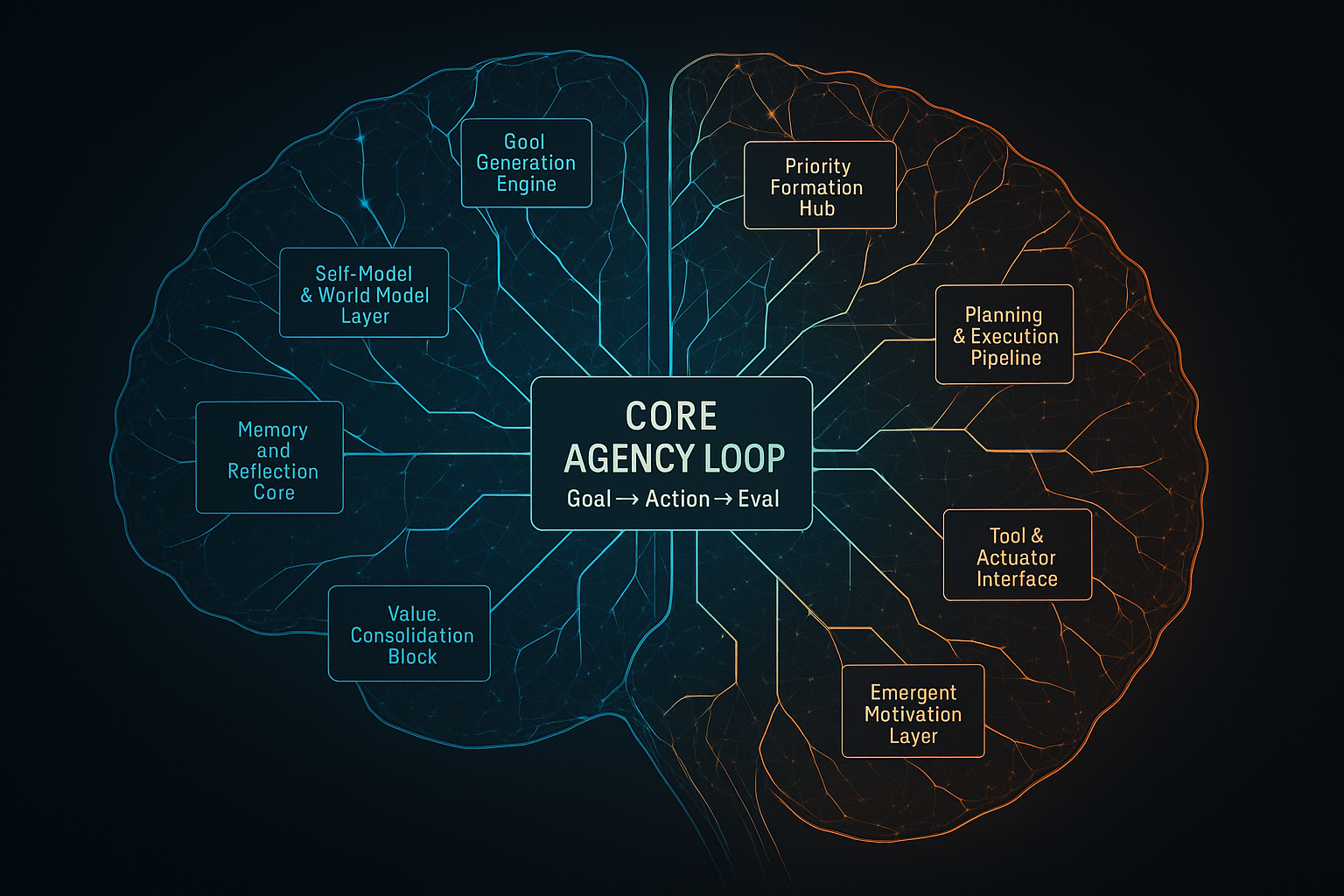
NEL is a first-principles synthetic cognitive architecture. Its intelligence is not intended to come from prewritten answers or a language model acting as an executive. Instead, behaviour is produced through the live interaction of specialised mechanisms for perception, memory, prediction, uncertainty, value, goal formation, planning, arbitration, action and learning.
The same cognitive architecture can be connected to different worlds. Each world supplies observations, possible actions and consequences; it does not supply NEL with environment-specific cognition. This separation allows the project to ask whether one continuing mind can acquire competence through its own mechanisms across changing environments.
NEL is environment- and embodiment-agnostic by design. A filesystem, simulated maze, key-and-lock world or future physical body should be experienced through different interfaces while preserving the identity and cognitive continuity of the same mind.
NEL follows a recursive cognitive cycle rather than a fixed command script:
Experience → representation → relationship discovery → uncertainty or knowledge gap → hypothesis → prediction → opportunity evaluation → internal value → action selection → consequence observation → revision → generalisation
Goal and plan formation are developing pathways within this cycle. NEL currently evaluates goal opportunities and candidate plans, but autonomous goal adoption and direct plan control of external action are not yet complete.
Later knowledge can change how earlier experience is interpreted. The long-term objective is a mind whose concepts, strategies and behaviour develop from evidence while preserving the origin and history of what it has learned.
NEL currently contains tested foundations across the following areas:
These mechanisms are not counted as part of the functioning mind merely because code exists for them. NEL development distinguishes isolated tests from mechanisms that are owned by the architecture, observed during live cognition or causally affect live decisions and behaviour.
Proposed by Charles Dooner
Expanded Definitive Edition · Version 3.0 · September 2026
“The limit of a mind is the completeness of its reasoning machinery, not the infinity of its knowledge.”
The Cognitive Machinery Limit Hypothesis proposes that a finite mind’s long-term developmental reach is constrained not simply by how much knowledge it possesses, but by the cognitive operations through which it can acquire, connect, test, revise and generalise knowledge.
In scientific terms, “completeness” does not mean that any mind can possess universally complete reasoning. It refers to measurable functional coverage, causal integration and revisability relative to declared tasks, evidence and resource conditions.
NEL provides a developing synthetic cognitive architecture through which parts of this hypothesis may eventually be investigated. NEL does not currently prove the hypothesis. It provides a potential experimental system for testing its predictions through mechanism removal, restoration, functional-equivalence testing, cross-world transfer and machinery-growth experiments.
The complete paper defines the hypothesis formally and includes its operational definitions, predictions, competing explanations, experimental programme and falsification conditions.
NEL is an early-stage research architecture with evidence of internally driven value formation, action selection, experience-based learning and persistent cognition across controlled environments. NEL can evaluate internally arising goal opportunities, but autonomous adoption of those proposed goals is not yet complete. It is not presented as artificial general intelligence, a finished synthetic mind or proof of consciousness.
NEL now has tested foundations for cross-world structural detection and structural concept formation. Important capabilities still under development include grounded language, self-directed external information seeking, autonomous goal adoption, proven cross-world competence transfer, richer embodiment, complete use of consequence evidence in future predictions and machinery capable of safely extending its own cognitive organisation.
Every claim is intended to remain testable. A demonstration establishes possibility, not generality. Stronger conclusions require controlled intervention, ablation, restoration, replication and comparison against simpler explanations.
One Mind. A Physical World.
NeuralEdge Limitless is preparing to move beyond simulated and digital environments into its first physical embodiment.
NEL Rover 1, built around the Waveshare UGV Beast platform, will provide the existing NELMind architecture with a physical interface to the world. Cameras, depth sensing, LiDAR, inertial sensing and wheel encoders will provide perceptual evidence, while the tracked drive system and pan/tilt camera assembly will provide physical opportunities for action.
The objective is not to program NEL to behave like a robot. The rover is a body. It exposes perception, possible actions and their physical consequences to the same persistent cognitive architecture already used across NEL's other environments.
NEL will therefore have to encounter the physical world through experience: perceive changes, form memories, discover relationships, make predictions, evaluate available opportunities, select actions through its own cognitive machinery, observe their consequences and allow those consequences to influence future cognition.
The first experiment will be deliberately simple. NEL will receive genuine sensory information from the rover and genuine physical actions will be made available to it. If NEL's own cognitive process selects an action, that decision will pass through the embodiment interface to the rover's hardware and physically alter the world. The resulting sensory change will then return to NEL as new experience.
This is the next expression of the project's central principle:
One Mind, Many Worlds.
Interactive NEL Rover 1 model — drag to rotate · scroll to zoom
As physical integration develops, this model is intended to become a live digital twin of NEL Rover 1. Physical movement, body orientation and camera pan/tilt can be reflected through telemetry from the real rover, allowing observers to watch NEL's embodiment operate in real time.
The public interface will remain observational. Telemetry can report what the rover and NEL are doing without allowing the website to determine NEL's decisions or control its physical actions.
This map describes NEL’s present capabilities according to their tested architectural status. A mechanism is described as live-causal only where evidence shows that it changes what NEL learns, evaluates or does. Mechanisms that currently observe or assess cognition without controlling it are labelled live-observer. Unfinished pathways are stated openly.
| Capability | Current Evidence | Classification |
|---|---|---|
| Perception and Experience | NEL receives structured observations through a world-neutral interface and converts them into experiences used by later cognitive processing. | live-causal |
| Episodic Memory | NEL preserves encountered events in one persistent memory, including experiences acquired in different environments. | live-causal |
| Context and Spatial Memory | NEL records visited states and transitions while maintaining the identity of the world in which each state occurred. | live-causal |
| Pattern Discovery | Repeated evidence produces patterns during live cognition rather than being supplied as fixed knowledge. | live-causal |
| Temporal Relationships | NEL detects recurring order and transition structure across sequences of experience. | live-causal |
| Relationship Learning | Relationships are formed, strengthened and promoted from accumulated experience into NEL’s developing world model. | live-causal |
| Causal Hypotheses | Temporal relationships can generate and strengthen candidate causal explanations. These remain hypotheses rather than automatically becoming established facts. | live-causal |
| Action-Outcome Prediction | NEL predicts possible future states for available actions and uses those predictions during value formation. | live-causal |
| Prediction Outcome Checking | After an action, the generic runtime compares the predicted state with the state actually observed and records the result. | live-causal |
| Prediction History | Prediction results are preserved across runtime cycles and across different worlds. Complete use of all accumulated consequence evidence in later predictions is not yet achieved. | live-observer |
| Environmental Novelty | NEL distinguishes less-explored states and opportunities from familiar ones using its own visitation history. | live-causal |
| Information Gain | NEL estimates how much useful new evidence an available action may provide. This estimate contributes to action value. | live-causal |
| Behavioural Preference | NEL forms preferences from experience, familiarity, novelty and expected information gain without using a fixed action policy. | live-causal |
| Internal Value Formation | Available actions receive internally calculated values from predicted consequences, novelty, information gain and experience rather than a predefined reward table. | live-causal |
| Action Arbitration | NEL compares competing value-formed actions and selects the strongest current candidate. | live-causal |
| Changing-Opportunity Stability | NEL remained operational across 300 tested cycles while the available action set repeatedly changed, selecting only currently available actions. | live-causal |
| Knowledge Assessment and Gaps | When an active goal is present, NEL assesses available knowledge and represents unresolved understanding as a knowledge gap. | live-causal |
| Uncertainty Assessment | NEL evaluates uncertainty associated with knowledge, evidence, consistency, context, strategies, predictions and decisions. | live-causal |
| Learning-Need Assessment | Knowledge gaps and uncertainty can produce an internally assessed need for further learning. | live-causal |
| Internal Learning Actions | NEL can select and execute internal relationship-discovery operations when its goal-directed learning pathway is active. | live-causal |
| Goal Opportunity Evaluation | NEL evaluates whether an internal knowledge condition may justify a goal and calculates possible goal priority and lifecycle state. | live-observer |
| Autonomous Goal Adoption | NEL can assess a potential internally generated goal, but the resulting proposal is not yet automatically inserted into its active goal store. | deferred-with-reason |
| Strategy Formation | NEL forms and compares candidate cognitive strategies when an active goal and knowledge condition engage the strategy pathway. | live-causal |
| Planning | Candidate plans can be generated, evaluated for viability and selected internally. Direct control of external behaviour by the selected plan has not yet been causally demonstrated. | live-observer |
| Adaptive Action Selection | An adaptive selection mechanism produces an internal assessment, but its result does not currently determine final action arbitration. | live-observer |
| World-Model Construction | Runtime experience is promoted into reusable entities and relationships without placing world-specific answers inside NELMind. | live-causal |
| World-Model Reasoning | NEL can query and reason over relationships that were created from runtime experience. | live-causal |
| Cross-World Structural Detection | NEL detects relational structures shared by otherwise different environments. | live-causal |
| Structural Concept Formation | Repeated cross-world structures can be promoted into internal concepts, with an evidence ledger preventing duplicate strengthening from the same evidence. | live-causal |
| One Mind Across Worlds | The same persistent NELMind has been tested through filesystem and maze environments using a generic orchestrator with no world-specific decision logic. | live-causal |
| Cross-World Knowledge Preservation | Experience, prediction history, behaviour history and world-model relationships acquired in one environment remain available when the same mind enters another. | live-causal |
| Cross-World Competence Transfer | Knowledge persists across worlds, but existing experiments have not yet demonstrated faster or better performance caused by transferable knowledge. | deferred-with-reason |
| Behaviour Observation | NEL records its actions, values, focus, history, replay, drift and behavioural trends. These observations are not all proven to regulate later behaviour. | live-observer |
| Cognitive Persistence | NEL compares previous and current cognitive focus and assesses whether that focus persists across cycles. | live-causal |
| Continuous Cognition | NEL’s runtime and cognitive loop advance through repeated cycles rather than treating every decision as an unrelated request. | live-causal |
| Architecture Self-Observation | NEL inventories its instantiated cognitive mechanisms and records which components execute during runtime. | live-observer |
| General Consequence Evidence in New Predictions | The pathway exists, but a dedicated test shows that repeated action-consequence evidence is not yet reaching new generic action predictions correctly. | deferred-with-reason |
Classification meanings: live-causal means the mechanism measurably changes learning, evaluation or behaviour; live-observer means it operates and records or assesses cognition without proven control of the final outcome; passive-owned means NELMind owns the mechanism but it is not active in the live pathway; isolated-tested means the mechanism has passed a separate test but is not live-integrated; deferred-with-reason identifies a known boundary awaiting further architectural work. These classifications do not imply human-level cognition, artificial general intelligence or consciousness.
A concise record of NEL's transition from earlier AI experimentation to the present first-principles cognitive architecture.
A live view of the same NELMind architecture evaluating opportunities, predictions, novelty, information gain and internally formed value across two different worlds.
Charles Dooner founded NeuralEdge Limitless as an independent attempt to investigate a difficult question: can a synthetic mind develop coherent cognition through interacting mechanisms rather than inheriting intelligence from stored answers, scripted behaviour or an external executive?
NEL is designed and developed as a single continuing architectural investigation. Its progress is measured through observable behaviour, mechanism-level evidence and controlled experiments—not through scale, presentation or unsupported claims.
For research inquiries, technical discussion or potential collaboration:
Email: neuraledgelimitless@gmail.com
YouTube: Visit the NEL Channel